Sunday, June 3, 2012

Metaliterature


"The Great Khan deciphered the signs, but the connection between them and the places visited remained uncertain..."

Since the vague beginning of the novel Marco Polo has taken the role of writer and narrator, which leaves us as the readers, to assimilate with Kublai Khan who serves as Marco Polo's audience. As mentioned in my previous blog, the book is divided into categories by their titles and though Calvino presents the index as a rigid outline, there are numerous ways of reading its context. When I began reading, I noticed that though each city is individually distinct, they are all built upon the same base. None of these cities are built of simple bricks and mortar. They are full of domes, crystal, curved arcades, aluminum springs, banisters and many other grand architectural designs. Once they have parted from this rather similar base, each city deals with different themes. The Cities & Memory for example are all philosophical stories experimenting with nostalgia and decline.

Though each of these cities are somehow correlated, I don't yet seem to understand really what it is that Calvino is expecting for us as readers to deduce from his piece. The Great Khan himself understands the individual characteristics that predominate each of the cities described to him, yet the overall connection and significance of these still remains uncertain.

So thats it. I am left in the abyss of uncertainty. Each scenario must eventually tie into a larger picture or maybe it is simply another attempt to give the insignificant a meaning. It’s writing about a writing that I hope I will some day come to understand.


Thursday, May 31, 2012

A Maze of Reality


“It is the desperate moment when we discover that this empire, which had seemed to us the sum of all wonders, is an endless formless ruin.”


In Invisible Cities, Italo Calvino seems to contrast a rigid outline structure with a flexible textual content. This is due to the numerical structure proposed in the novels index and the fluidity among each of the independent "utopias" described as cities. The opposition between form and content seem to serve as fruitful dichotomy in the conception of the novel itself. But why create such a complex outline for the reader, yet open the door for them to interchangeably read your work? 

Here are some possibilities

By checking the index, the reader will detect a total of nine chapters in the book. A more detailed inspection will reveal an interesting progression of titles and numbers. You will notice this succession follows an orderly sequence and the use of a substitution principle, which in other words means that if A is equal to B than B is equal to A. Though the criterion employed by the author at first may seem like a rare coincidence or to many others be a display of profound symbolism that is way beyond your own personal knowledge, it is actually an indicative of a method applied in the organization of the book. 


Whether the reader chooses to explore it by examining the texts under the topics proposed (Cities & Desire, Cities & the Dead, etc.), or by analyzing all the narratives which fall under a specific number on the index, according to the sequence 54321; Calvino’s Invisible Cities seems to unlock its texts to a range of possible ways of reading. Which can only mean that its’ bundled disposition allows the blocks to be individualized without loss for its entirety. In essence, Calvino’s procedure consists in using a “framework” to bring together the short narratives which form the book, giving a sense of closure. Which results in the precision of structure set down in the index being an attempt to place meaning to the book for the readers own comfort, which in larger picture terms is the constant display of us humans trying to give significance to life. 

Thursday, February 23, 2012

Eternal Sunshine of the Spotless Mind

I concluded Candide with many things on my mind. The novel has rot me to my core. Apparently human beings do not suffer only as a result of political oppression, war, or natural disaster, but also from their own intrinsic flaws. Up to this point, all of the characters have been marvelously adept at getting themselves out of difficult or unfortunate situations. The one site of tranquility and joy presented throughout the novel, is the paradise of Eldorado, which Candide and Cacambo choose to leave soon after their arrival. At the time, their decision to venture back into the world seemed unwise and puzzling. Now I myself have created a thesis as to why the men decided to close the door to their own happiness. Boredom.

"We must go and work our garden."

The cure for the crushing boredom described in the previous quotation has been found in the hard work of gardening. Ironic and quite simple seems to be the solution presented. As Pangloss pointed out, this cure recalls the state of mankind in the garden of Eden, where man was master of all things. Primitive innocence predominated the human race, so in their small plot of land, these characters would in theory seem to have a control over life and the destiny which they could have not have achieved up to this point.

The plague would have eventually hit them, due to the fact that perfection brings about no thrill, which comes to show that humans prefer to be doing something, weather it is "being raped a hundred times by negro pirates, having a buttock cut off, running the gauntlet in the Bulgar army, being flogged and hanged in an auto-da-fé, being dissected and rowing in the galleys," experiencing, in a word, misery, rather than living in the peak of boredom with no life to propel and drive them forward. Boredom, as Martin would describe it, seems to result not from the absence of happiness, but from the absence of suffering; life itself.


Tuesday, February 21, 2012

We are condemned to be free.

In mid of the adventure, Candide hires Martin, a downtrodden scholar, to accompany him on his journey from Buenos Aires to France. Martin embodies the polar opposite philosophical standpoint of Pangloss and Candide’s, as believes that the world is inherently evil and all semblance of good is fleeting. He presents himself against the public as a Manichaeist; a pessimist human being, who believes that God has abandoned the world and now evil existent force since it has merely shadowed society. 
As the men draw closer to the shore of France, Martin pans France as a country where the "ruling passion is love, the next is slander, and the last is to talk nonsense." The scholar describes Paris as "confused multitude, where everyone seeks for pleasure without being able to find it." The men's discussion takes a philosophical turn when Candide asks for what exact reason the world was formed. "To make us mad" is the response. Was mankind always so brutal to one another, guilty of "lies, fraud, treachery, ingratitude, inconstancy, envy, ambition, and cruelty? If animals have not evolved in their nature, why should humans be expected to do so? The difference between animals and men is free will."

Is there a freedom of will within man from sin and its dominion, and to what extent does it go? This is what I ask myself. Primitive innocence, as the bible depicts it, is the way God brings man into the world. That of subsequent corruption, into which he fell through dethrones men of that primitive innocence. In the case of Adam and Eve, who tasted of the tree of knowledge, they became corrupt, which means that innocence for all humanity had perished, it had been taken. 
So no, I beg to differ with Martin. In my opinion man does not have free will, because yes, though he or she chooses to wander out into the open and feed themselves with knowledge or "outer evil," they have since the beginning been condemned to sin. Therefore I think that man and animal do share equal predestination. We are as we have wired ourselves to be. Therefore the value of choice does not exist. 

Thursday, February 16, 2012

Candide's Personal Dystopia


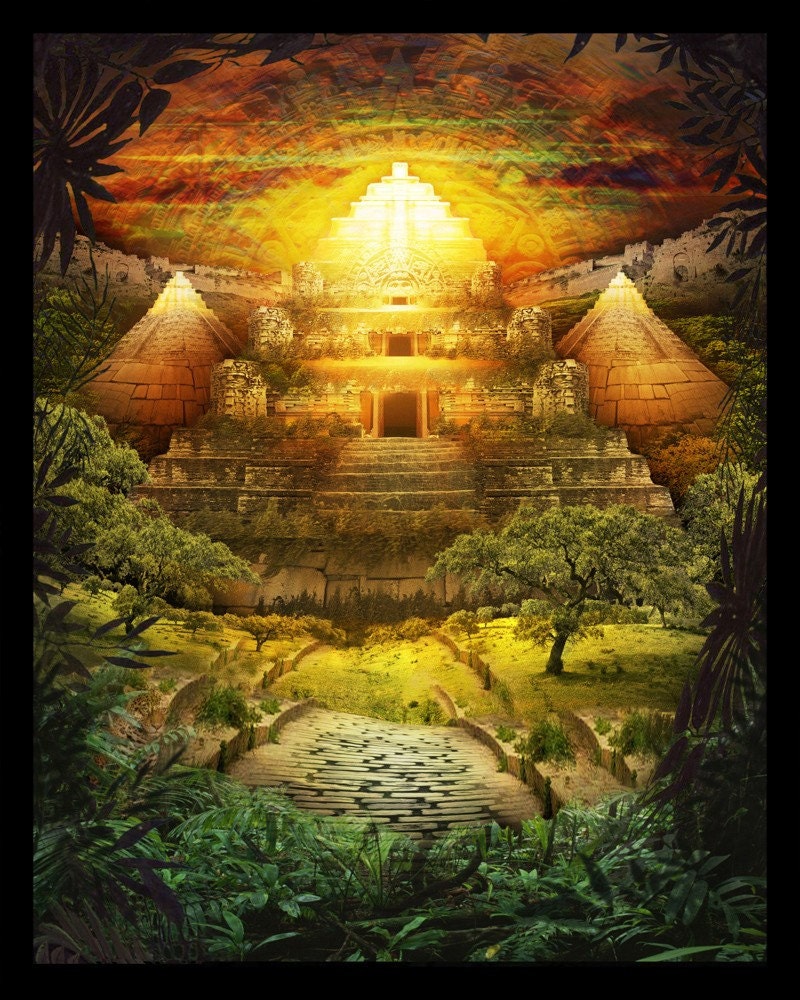
In chapter 17, Candide stumbles upon a secluded, idyllic city in South America called Eldorado where the streets are paved with gold and precious stones, and poverty is non-existent. Everyone seems to live in perfect harmony. However, Candide voluntarily leaves "this earthly paradise" not long after arriving.

Why?

So far in the novel we have only seen death and destruction, a morbid dystopia where darkness and despair hit Candide at every turn, which in theory means that now that he has come upon Eldorado he will live unprejudiced, "happy" environment. For Candide, the reasoning behind his departure in my opinion is that in the world of Eldorado they will always be no one; they will be like any other inhabitant. But if they leave with the "stones and mud" of the country and return to reality they can live like kings and be revered. They are driven by this, as well as an insatiable desire for adventure and Candide's longing to return to his true love.

We notice through Candide that though people crave for eternal perfection, they seem to understand that utopias are not meant for them. They have always resided in worlds of turmoil, and although many aspects of the two societies are enjoyed and believed to be 'the best of all possible worlds' as Pangloss would say, it is not a place that they truly belong.


Monday, February 13, 2012

Life's Lovely Burden

The old woman was born the daughter of a Pope. She has experienced the death of her fiancé, been raped by pirates, sold into slavery, been a victim of cannibalism in wartime, and eventually ends up becoming Cunégonde’s servant. Her misfortunes have made her cynical about human nature, but she has somehow managed to not give in to self-pity. As the old woman narrates her life story, she makes an interesting parallel of life and death: 

—A hundred times I wanted to kill myself, but always I loved life more. This ridiculous weakness is perhaps one of our worst instincts; is anything more stupid than choosing to carry a burden that really one wants to cast on the ground? to hold existence in horror, and yet to cling to it? to fondle the serpent which devours us till it has eaten out our heart? —In the countries through which I have been forced to wander, in the taverns where I have had to work, I have seen a vast number of people who hated their existence; but I never saw more than a dozen who deliberately put an end to their own misery.

"A hundred times I wanted to kill myself, but always I loved life more." The absurdity of this first sentence was the reason it caught my attention; I mean how does one want or have wanted in the past to kill themselves if life is explicitly seen as something "more beautiful?" 
Also, the pessimism of this passage is quite obvious and in my opinion fairly thorough. The only gleam of hope that seems to be shining through the old woman’s words, come from her affirming that people cling on to life because they “love” it and not because they are resigned or fear eternal punishment, which is ironic since she is the daughter of a Pope. The old woman in theory, should have been raised in a religious environment were eternal salvation and God predominated life and the fact that she is no way acknowledging the existence of God in her arguments is a rather more modernistic mentality than that of 19th century France. 
The only slight biblical reference made throughout the entire passage is that of the serpent or Satan, in which this sly and treacherous representation of life is not only tolerated but “fondle[d].” Human beings, then, naturally embrace life—a “stupid” move, perhaps, but one that demonstrates passion, strong will, and an almost heroic and optimistic endurance.

Saturday, February 11, 2012

Bittersweet Fairy Tale


Chapters 6-11 had various things, which stuck out to me. I would like to talk about the two that I myself found worthy mentioning: Jacques' death and Cunegonde's reappearance. 
The significance of Jacques' death to me remains inconclusive. I have two possible theories and or interpretations to it, so I will simply lay them out and let the reader burden him or herself with the answer. Here it goes. 
Option 1. Jacques' death could represent Voltaire's criticism of the optimistic belief that evil is always balanced by good. In this case being Jacques the "good one", that perishes while saving a sailor, who's sensual indulgence in the face of death is grotesque and inhumane, which presents the obvious case of evil overpowering good and not the classic balance of powers as it should be. Option 2. Jacques' death could also represent the uselessness of Christian values. Referred to many times as "the Anabaptist," Jacques is an altruist, meaning that he lives life by "giving and receiving" which is amusing considering the fact that he ends up being a victim of his own altruism as he lends a helping hand to receive death as his compensation. 
Cunegonde's situation on the other hand also inspires a similarly subversive combination of horror and absurdity. Her story on the surface demonstrates the obvious demented lack of respect that was lent to woman in the 18th century, since they were bought and sold like a piece of livestock. But beyond the rights a woman was ceased to in the era, what really drew me to ultimately enjoying these last few chapters of todays reading was the dramatic love triangle of rage, jealousy, and possesitivity between Cunegonde and her "masters." Also, the fact that Candide "heroically" ends up killing these men, in my opinion gave the book an almost fairytale-like ending, in which two young lovers that fought off "evil", go on to live happily ever after. 
FIN 

Wednesday, February 8, 2012

Is the glass half empty of half full?

...those who say everything well are uttering mere stupidities; they should say everything is for the best. 


Master Pangloss, the greatest philospher in Westphalia, is the man that holds the indomitable belief that human beings live in "the best of all possible worlds." This optimistic philosophy of life is one of the most important points manifested in the first few chapters of the book, due to the fact that it constantly comes under brutal attack with each of the never ending misfortunes of Candide. 
Take the scene when Candide finds a deformed beggar in the street. It turns out that it is Pangloss, who currently finds himself not only homeless, because the Bulgars attacked the Baron's castle and killed everyone inside it, but also consumed by syphilis which he contracted from Paquette. 
The irony and absurdity of the situation becomes visible when Pangloss' "marvelous" life philosophy comes into play, as he says that syphilis is necessary in the best of the worlds because the line of infection leads back to a man who who traveled to the New World with Columbus, and if Columbus had not traveled to the New World and brought syphilis back to Europe then Europeans would also have not enjoyed New World wonders such as chocolate. 
This in my opinion is a ridiculous mock to intellectuals of the Enlightenment Era, making Pangloss the perfect parody to the all ideal philosopher of the time.